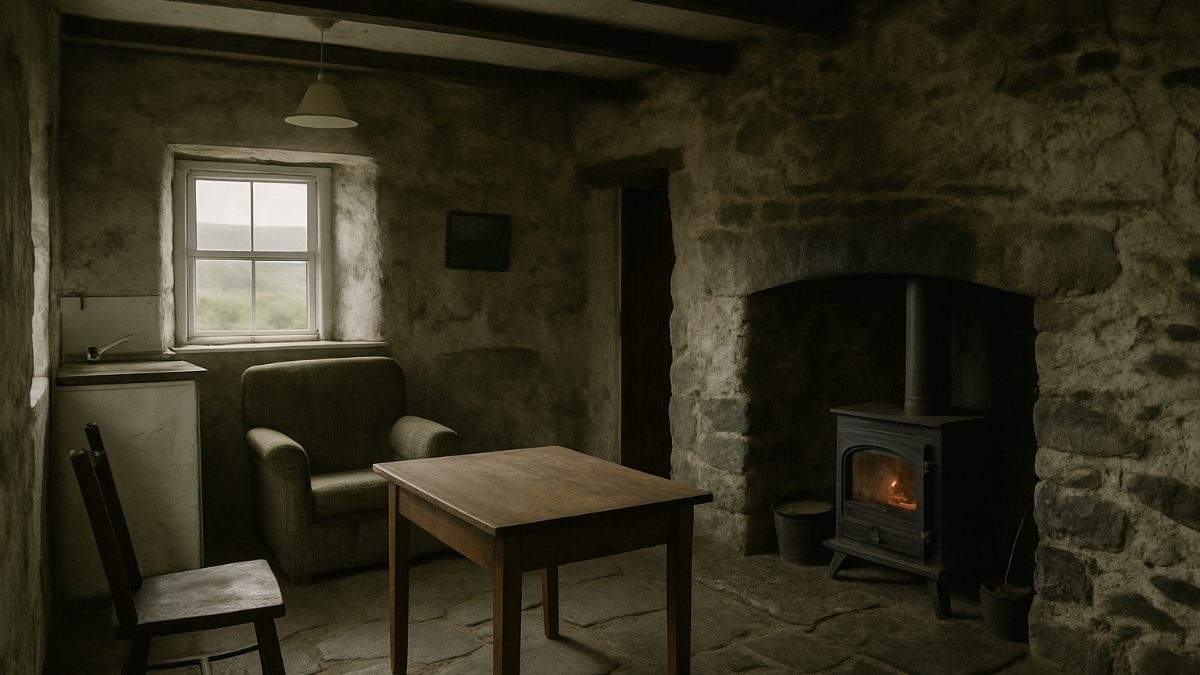
The cottage had been standing for well over a hundred years before I got my hands on it. Stone walls half a metre thick, a north-facing gable that takes the full force of whatever comes in off the Atlantic, and a general atmosphere of cheerful indifference to human comfort. I bought it knowing it needed work. What I did not fully appreciate was how differently a building like this behaves compared to a standard modern house, and how badly wrong you can go by applying standard modern thinking to it.
I made three significant insulation mistakes in the first two years. I am writing this down partly because it cost me money to learn these things, and partly because I have since spoken to neighbours who made the same errors. None of this is exotic or unusual along the West Cork coast. It is just what happens when you follow generic advice in a marine environment that does not behave generically.
Mistake one: rigid foam board on the inside of the stone walls
This felt logical at the time. The walls were cold, I wanted insulation, and closed-cell rigid foam boards have impressive thermal values on paper. A builder I used, well-meaning but more used to working on newer builds, suggested fixing them directly to the inner face of the stone with adhesive and then plastering over. We did two rooms this way.
Within eighteen months, I had damp patches forming behind the boards in one corner. The problem is that old lime-built stone walls are breathable by design. They absorb moisture and release it. Blocking that process on the inside traps moisture within the wall structure, and in a coastal location with consistently high ambient humidity, that moisture has nowhere to go. The wall stays wet. Wet walls lose their thermal performance anyway, and you begin to get problems with the structure itself over time.
What works better here is a breathable internal insulation system, most commonly a lime-based insulating plaster or a woodfibre board fixed with appropriate breathable adhesive and finished with a lime skim. It is more expensive upfront and not every builder is familiar with it, but it works with the wall rather than against it. The wall can still move moisture out. That matters enormously in a marine climate.
Mistake two: standard mineral wool in a poorly ventilated roof space
The cottage has a simple pitched roof and I had the roof space insulated at the joists with mineral wool, thinking that was a reasonable job done. It probably would be fine in a drier inland setting. On the coast here, especially through autumn and winter, condensation was forming on the underside of the roof timbers above the insulation. The warm moist air from the rooms below was hitting cold surfaces and leaving water behind. Over a couple of winters that is the beginning of a timber problem.
The fix involved improving ventilation at the eaves and ridge, and using a breathable membrane below the slates rather than the impermeable felt that was already there. Replacing the felt meant taking up a section of the roof, which was a significant cost. Had I thought about ventilation from the start, it would have been far cheaper to address during the original work. If you are doing any roof work on an older coastal property, it is worth asking specifically about breathable underlays and eaves ventilation before anyone starts.
Mistake three: assuming the grant scheme covered what I was actually doing
I had looked at the SEAI grants available for home insulation and assumed my planned work would qualify without checking the details carefully. Some of what I wanted to do with breathable lime-based systems did not straightforwardly fit the standard grant categories at the time. I ended up doing part of the work in a way that qualified for a grant but was not the right solution for the building, and paying out of pocket for the corrections later. The lesson is to read the scheme conditions carefully before you commit to materials or contractors, and ideally to speak to someone who has experience of applying for grants on older vernacular buildings. The rules do change, and there are sometimes pathways for older stone buildings that are not immediately obvious.
None of this is meant to put anyone off buying or improving an old coastal cottage. These buildings are genuinely worth preserving and living in. The tradition of working with natural materials along Ireland's Atlantic coast runs deep, and there is something fitting about using lime and timber and breathable systems in a building that was originally constructed with exactly that kind of thinking. The walls know what they are doing if you let them.
The practical starting point, if you are facing similar decisions, is to find a builder or energy assessor who has actually worked on pre-1940s stone buildings in a coastal county. Ask them directly whether they have done breathable retrofits before. The answers you get will tell you quickly whether they are the right person for the job.