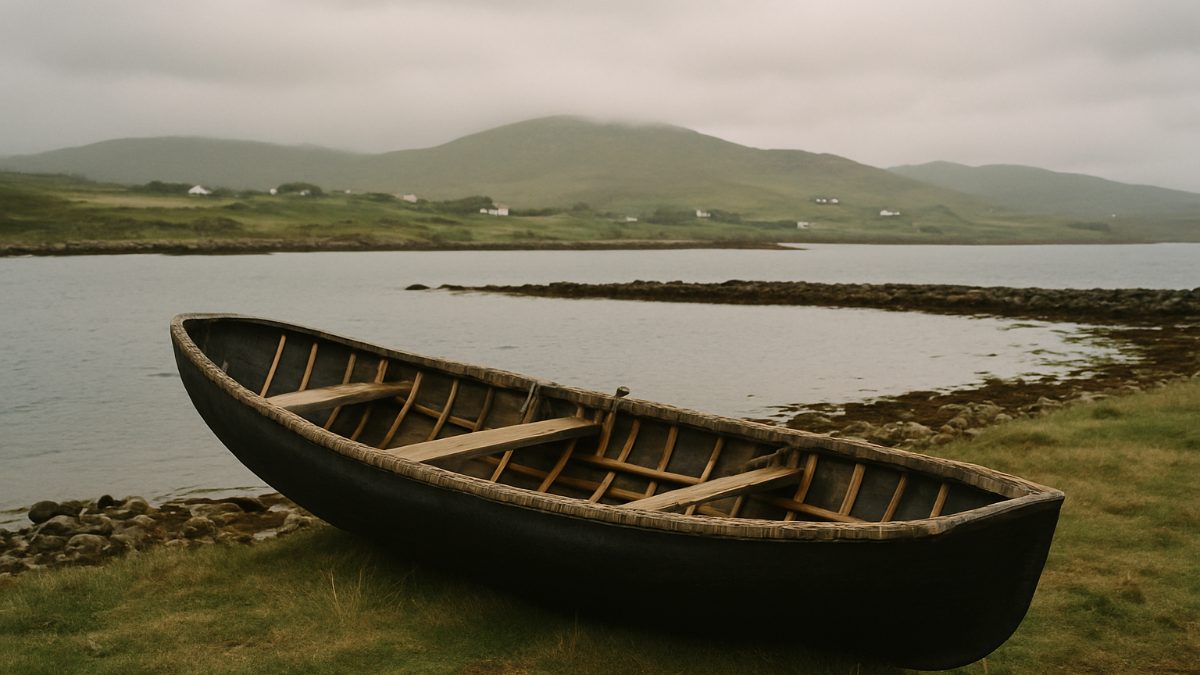
There is a tendency, when something old survives into the present, to treat it as fragile. To put it behind glass. The currach has attracted that kind of thinking for decades, the idea that it belongs in a folk museum in Tuam or as a prop for a tourism brochure, something to be admired rather than used. In Connemara, that thinking is wrong, and the people who build and work these boats will tell you so plainly.
The currach is a working vessel. It always has been. Along the Connemara coastline, from Roundstone down through the islands and inlets, boats are still being built by hand using skills passed between generations not because of any heritage grant or cultural preservation scheme, but because the boats are genuinely useful. They handle shallow water. They land on rocky shores where nothing else would manage. They are light enough to carry. These are not romantic virtues. They are practical ones.
What gets missed in the conversation about traditional craft is the economic dimension. A skilled currach builder in Connemara is running a small business. Orders come in for working boats, for rowing clubs, for private buyers who want something built properly. The craft supports livelihoods. It sits inside a local economy of timber suppliers, canvas and hide merchants, transport, and instruction. When a craft has that kind of economic reality behind it, it is not in decline. It is alive.
There is also the question of knowledge. The decisions a currach builder makes, how to set the frame, how to read the flex of the timber, how to judge the weight distribution for a particular stretch of water, cannot be looked up in a manual. That knowledge exists in the hands and the eye of the person who learned it from someone who learned it before them. Once it breaks, it does not come back, not fully. This is not nostalgia. It is a straightforward observation about how certain kinds of expertise work.
The broader culture around the currach matters too. Racing, which is serious competitive sport along this coast, keeps younger people connected to the boats. Rowing clubs in Connemara draw in participants who might never have considered building, but who end up curious about how the thing they are sitting in actually came to exist. That curiosity is a recruitment pipeline, even if nobody calls it that. The traces left by a life lived close to the shore are not just physical objects. They are habits of attention, and the currach builds that attention in people.
None of this means the craft is without pressure. Younger people face the same economic uncertainties as everyone else in rural Ireland. Workshop space costs money. Time to apprentice costs money. These are real problems and they deserve practical solutions, not just warm words about cultural heritage.
But the starting point has to be correct. The currach is not a relic. It is not maintained out of sentiment. It earns its place on the water and in the economy of the communities that build it. Treating it otherwise does a disservice to the people who have kept it there, and to the craft itself.