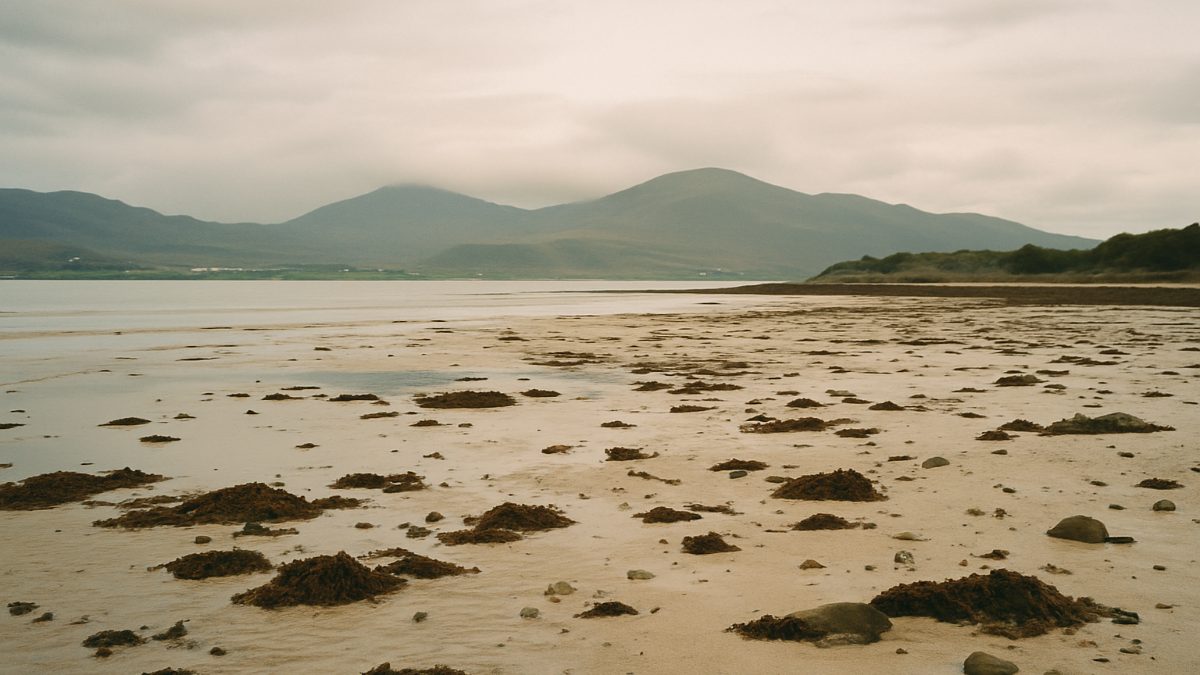
The alarm went off at half six and I nearly ignored it. The previous night's rain had cleared and the sky through the curtain was that pale grey-pink that either means a fine morning or another front moving in. I pulled on an old jacket and drove the short road down to Mulranny strand before I had time to talk myself out of it.
Low tide had left the beach wider than most people ever see it. The sand was dark and packed near the waterline, strewn with the usual mess: bladderwrack, kelp torn from rocks offshore, a few plastic bottles, a length of blue polypropylene rope. The kind of scene that might look like nothing much. But I have started, over the past few years, to pay closer attention to what ends up on an Irish beach after a tide, because it tells you something about what is happening out there in the water, and what has been happening for much longer than we tend to think.
The rope was the first thing I crouched down to look at properly. It was weathered enough that its original stiffness was long gone. Rope like this turns up constantly on Atlantic-facing shores. A lot of it comes from fishing operations, either lost overboard or cut loose from lobster and crab pots. Some of it drifts enormous distances before it comes ashore. The Mayo coast has always been a fishing coast, and gear lost at sea has always washed back eventually. You find this same connection between working the sea and losing things to the sea in every coastal county from Donegal to Kerry.
Further along the strand I found the remains of a wooden pallet, partly broken up but with several slats intact. Wood like that tends to have travelled. It could have fallen from a container ship, slipped from a pier, or been tossed by a storm. Driftwood has a long history of practical use in coastal communities here. In areas where timber was scarce and expensive, anything that came in on the tide could end up as fencing, furniture, or fuel. A few people in rural coastal areas still collect it, which seems entirely reasonable to me.
The shells were what I lingered over longest. Razorfish shells in long curved pairs, common periwinkles, a handful of dog cockles with the ribbed surface still distinct. There were also two larger shells I could not immediately place, slightly heavier and more rounded than anything I usually see on this stretch. I am not a biologist and I will not pretend otherwise. I took a photograph and looked them up later: they appeared to be horse mussels, which live offshore on gravel beds and only appear on the beach when they have been dug up by wave action or something has been feeding on them. Horse mussel beds are considered ecologically significant along the Irish coast, which gave those two shells a bit more weight in my mind.
Mulranny itself sits on a narrow peninsula at the head of Clew Bay, which means the strand there sees tidal material washing in from a wide area, including from the inner bay where traditional fishing for salmon, mackerel and shellfish has been practised for generations. There is something particular about walking a beach in a place like this, where the surrounding water has such a long record of human use. The debris is not just litter or natural cast-off. It is evidence of ongoing activity, of weather patterns, of trade routes, of how people still earn a living from these waters.
If you are spending time on this part of the Mayo coast, planning a walking route along the Wild Atlantic Way gives you access to several strands within a short distance of each other, each with its own character depending on aspect and tidal range. Mulranny is one of the quieter ones, especially early in the morning before the walking trail gets busy.
I drove back at around half eight with a small bag of rope offcuts and a few plastic bottles for the bin. The horse mussel shells I left where they were. You do not need to take everything. It is enough sometimes to have actually looked at it.