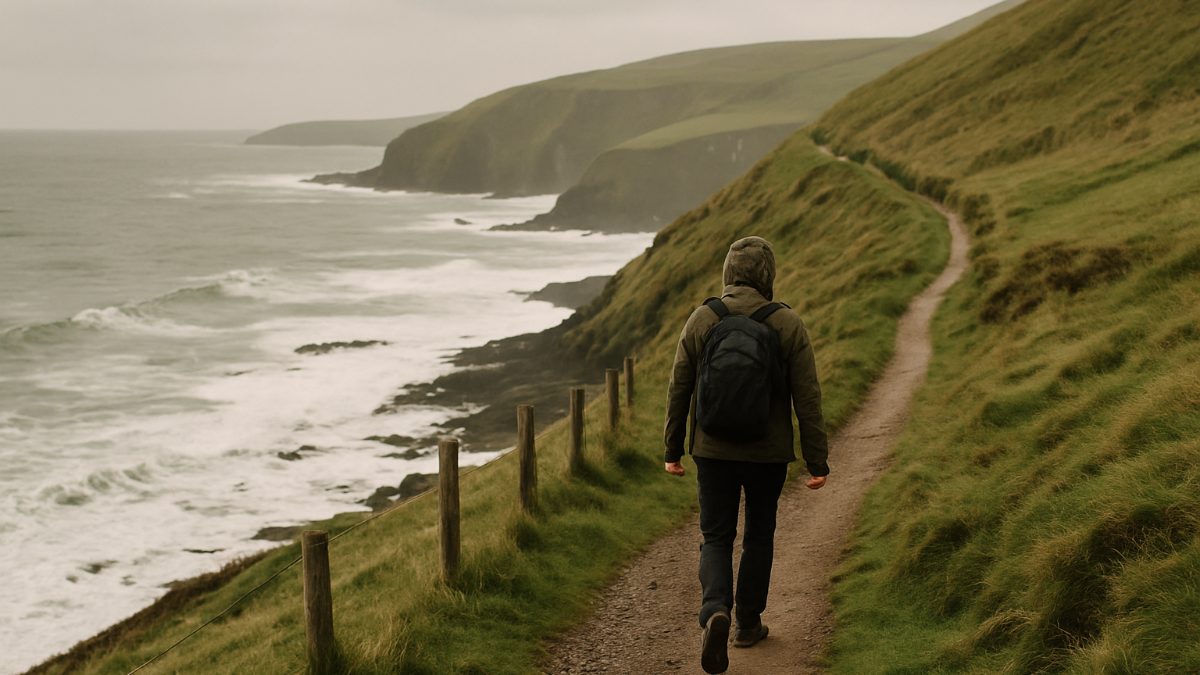
A walking holiday along the Wild Atlantic Way is one of the finest things you can do in this country, but the assumption that you need a car to make it work puts a lot of people off before they've even started. It shouldn't. With some planning, a bit of patience, and a willingness to ask locally when things don't go to plan, you can string together a proper coastal walking trip using buses, trains, local taxis, and the scheduled ferries that still run along parts of the western seaboard.
It takes more preparation than driving, but that's not a bad thing. You'll think more carefully about each section, you'll talk to more people, and you'll arrive somewhere tired in the good way, knowing you actually earned the view.
Start by choosing a corridor, not a destination
The Wild Atlantic Way runs for roughly 2,500 kilometres from Donegal to Cork. Nobody walks the whole thing in one go, and you don't need to pretend otherwise. The first step is picking a corridor of maybe three to five days' walking distance that has reasonable transport connections at each end.
Some sections suit car-free travel far better than others. The Mullet Peninsula, the Beara Peninsula, the Sheep's Head, parts of the Donegal coast around Malin Head, and the stretch of Mayo coastline around Achill and Mulranny all have enough infrastructure, or enough community taxi services and local knowledge, to make them workable. Avoid planning to start or finish in a place where the nearest bus stop is twelve kilometres from the trailhead. It sounds obvious, but it catches people out.
Map your transport anchors first
Before you look at walking routes in any detail, identify your transport anchors: the towns or villages where Bus Eireann, the local Link buses, or a train station gives you a reliable way in and out. These become your start and end points. Everything else, the actual walking, the accommodation, the ferry crossings, gets planned around them.
For the Mayo and Galway coast, Westport and Galway city are solid anchors. Clifden is reachable by bus. Killary Harbour sits in between and is harder, but local operators run shuttles in summer. In Kerry, Killarney and Tralee both have train connections, and there are regular buses out to places like Cahersiveen and Portmagee. In Donegal, Letterkenny is the hub, with onward connections to Dungloe and the Rosses.
Write your anchors down, check the actual timetables on the Transport for Ireland journey planner, and be honest about what's realistic. A bus that runs twice a week on Tuesdays and Thursdays is not a reliable escape route if you're finishing a long walk on a Saturday.
Build in a taxi day
Almost every rural coastal area in Ireland has a local taxi driver, sometimes just one, who knows every boreen and can collect you from a headland or drop you at a trailhead that no scheduled service would ever reach. These drivers are usually findable through your accommodation, the local shop, or a simple search for the nearest town. Ring ahead, be specific about where you need to go, and book it the day before.
A taxi day isn't cheating. It's a legitimate part of car-free travel in rural Ireland. If you're walking a linear route and need to be at a particular point by midday to catch a ferry, a local taxi for the first few kilometres is often the thing that makes the whole day possible.
Use the ferries where they run
There are still scheduled passenger ferries running along parts of the western coast, and they're genuinely useful for walkers. The Killimer to Tarbert crossing over the Shannon saves hours of road walking. Ferries run to Clare Island and Inishbofin off the Mayo and Galway coasts. The Valentia Island ferry in Kerry, though short, means you can cross without walking back the same road.
Check whether the ferry is seasonal. Many run from Easter to September or October only. Some have reduced sailings outside the school holidays. If your trip falls in shoulder season, ring the operator directly rather than relying on a website that may not have been updated since the previous year.
Plan your accommodation as a logistics tool
Where you sleep shapes everything else. On a car-free walking trip, your accommodation needs to be either at the end of that day's walk or reachable without a long detour. Aim for places that offer an evening meal or are within walking distance of a pub that serves food, because you won't want to organise a taxi to a restaurant after ten kilometres on a coast path.
Hostels, guesthouses, and small family-run B&Bs in coastal villages tend to be more flexible about drying rooms, packed lunches, and early starts than larger hotels. They're also more likely to know exactly who to ring if you need a lift.
Leave slack in the schedule
Weather changes things. A bus runs late. A ferry is cancelled because of swell. These are realities of the western Irish coast, and if your itinerary has no room for any of it, the trip becomes stressful rather than enjoyable.
Build in at least one full spare day across a week-long trip. If you don't need it, use it to walk somewhere slow and without purpose, maybe somewhere like a morning on the strand at Mulranny, where the tide dictates the pace rather than a timetable.
The practical rule is this: plan your transport connections with care, then give yourself enough time that missing one doesn't ruin the next three days. That balance is what makes a car-free coastal walk actually pleasurable rather than an exercise in anxiety management.