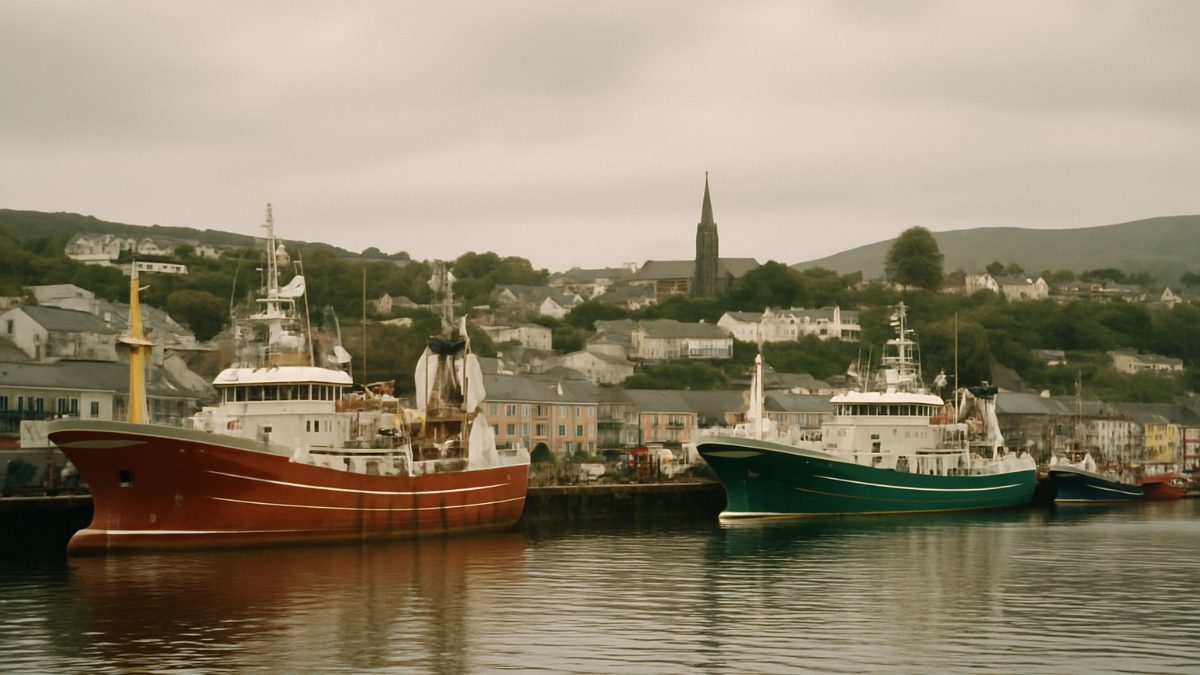
A Small Harbour With Big Ambitions
Killybegs sits on the southern shore of Donegal Bay, tucked into a natural harbour that keeps the worst of the Atlantic weather at bay. For much of its early history it was a modest fishing village, not unlike dozens of others scattered along the west coast. What changed it was a combination of geography, policy, and the sheer determination of the people who lived and worked there.
The harbour itself is unusually deep and sheltered. Ships can come and go in conditions that would close most Irish ports, which matters enormously in a business where time and weather are everything. That natural advantage was always there. What took time was building the infrastructure around it.
How the Port Grew
The real expansion of Killybegs began in the middle decades of the twentieth century. Irish fisheries policy at the time was encouraging modernisation, and investment started flowing into the port, dredging, extending the quays, building cold storage and processing facilities. Fishing families who had worked with smaller inshore boats began moving to larger vessels capable of working further offshore.
By the 1970s and into the 1980s, Killybegs was landing more fish by weight than any other port in the country. Mackerel in particular came in enormous quantities during the boom years of the pelagic fishery. Huge refrigerated vessels from Norway and other northern European countries would call at Killybegs to offload their catches for processing. The town's population, which might have declined like so many rural Donegal communities, instead held steady and in some periods grew.
The European Union's Common Fisheries Policy, which Ireland joined along with the EEC in 1973, shaped things considerably. Quota systems, landing rules and fleet regulations all left their mark on how the port operated. There were difficult periods when quotas tightened and smaller operators struggled, but Killybegs adapted. The processing industry in particular became a significant employer, meaning the port was not entirely dependent on what Irish boats landed themselves.
What the Port Looks Like Now
If you drive into Killybegs today, the scale of it is the first thing you notice. The quayside is long and working, with large pelagic vessels tied up alongside smaller trawlers. There are processing plants close to the water, lorries moving in and out, forklifts on the pier. It does not look like a heritage attraction. It looks like a place with a job to do.
The main species landed include mackerel, herring, blue whiting and horse mackerel, most of it caught by the large pelagic fleet that operates out of Killybegs but ranges far into the north Atlantic. There are also demersal boats, working for whitefish like haddock and hake. The catch volumes fluctuate year to year depending on quota allocations and fish availability, but Killybegs consistently handles the bulk of Ireland's total fish landings by value.
The town behind the port is small by any measure, a few thousand people, but it has the practical feel of a place that earns its living rather than performing it. There are chandleries, engineering firms that service vessel equipment, net-making operations. The support trades that grow up around a serious working port are all present.
The Human Side of It
Fishing families here have been at this for generations, and you get that sense quickly in conversation with anyone from the town. The sea is not romanticised the way it sometimes is by people who do not depend on it. It is weather, and quota, and the price fish are making at the factory gate, and whether the boat needs work before the next trip.
There is a maritime heritage aspect to Killybegs as well, though it sits quietly alongside the commercial activity. The town has a small carpet-weaving tradition that predates the modern fishing industry, and the Killybegs International Carpet Making and Fishing Museum gives some sense of the broader history of the place. It is worth an hour or two if you are passing through.
For anyone travelling the northwest coast and interested in what a real working Irish fishery looks like, Killybegs is the place to see it. The Wild Atlantic Way passes through this part of Donegal, and it is easy enough to build a stop here into a longer coastal journey. Go in the morning if you can, when the quays are busy and the work of the port is most visible.