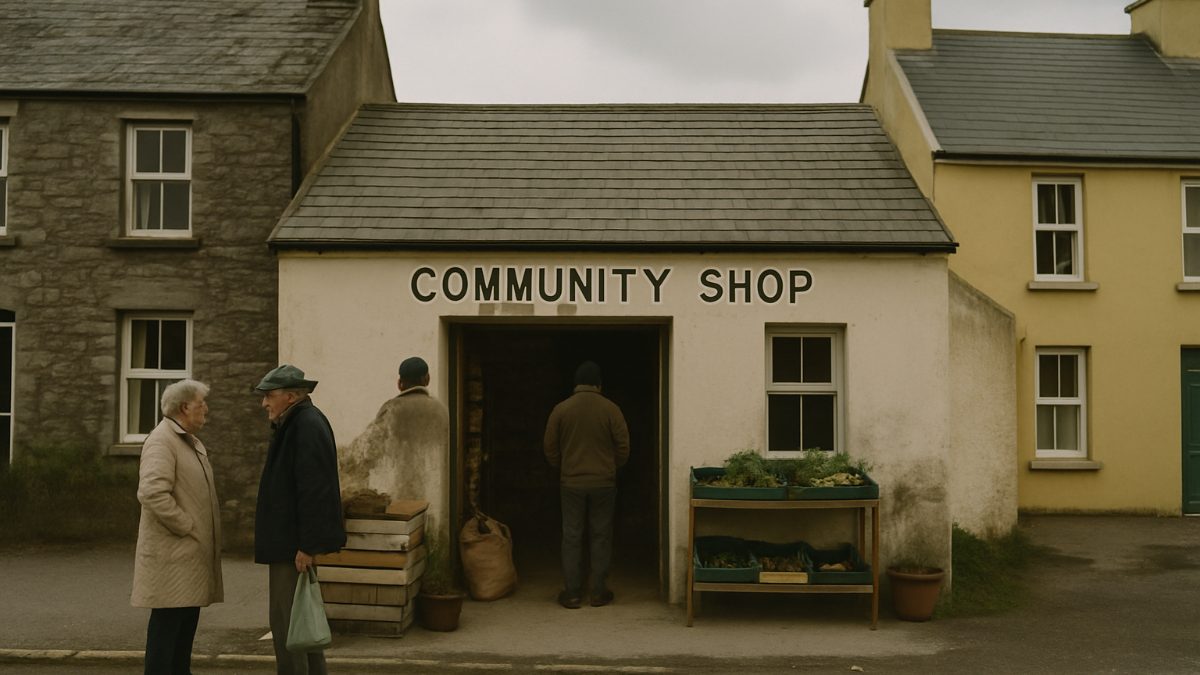
There is a shop in a small harbour village on the Kerry coast that has been open, without interruption, for the better part of thirty years. It sells bread, newspapers, vegetables, fishing line, wellingtons, and whatever people happen to need that week. It closes at a reasonable hour. It is run, in practical terms, by the community that uses it.
That is not a remarkable thing to say about a shop in a town. It is a remarkable thing to say about a village with fewer than four hundred people, situated on a peninsula where the nearest supermarket is a forty-minute drive, and where the winters are long and the tourist trade disappears around October.
I first heard about this place from someone who had grown up in a similar village in west Cork and had watched their own local shop close in the late nineties, followed by the post office, followed by the pub. That kind of slow unravelling is a familiar story in rural coastal Ireland. Which is why the Kerry example is worth looking at properly, not as a feel-good story, but as a model.
How it actually works
The shop is registered as a cooperative, which is the key structural fact. The community raised the initial capital by selling shares, at a modest and accessible price, to local households. That meant people in the village were investors from the start, not just customers. They had a direct reason to use the shop and to want it to survive.
The cooperative structure also meant that profits, in the years when there were profits, were either reinvested in the business or distributed to shareholders rather than leaving the area entirely. And in the years when there were no profits, the people making decisions about how to respond were local people with a stake in the outcome. That matters more than it might seem.
A small committee handles governance. Members are elected at an annual meeting. The day-to-day management is paid work, not volunteer work, which is an important distinction. Many community ventures in rural Ireland collapse because they are built on goodwill and goodwill eventually runs out. A paid manager with a proper contract is a more durable foundation.
What kept it running through the difficult years
The shop nearly closed twice. Once in the mid-2000s when a larger retail chain opened a smaller format store about twenty kilometres away, and once during the recession when several of the peninsula's main employers scaled back significantly. Both times the committee had to make hard choices about stock, opening hours, and cost.
What helped, both times, was that the shop had diversified. It was never just a shop. It took on the local post office counter. It became an informal collection point for parcels. It started stocking items, particularly for fishing and boat maintenance, that the big chains did not bother with. It made itself harder to replace.
The post office element deserves emphasis. Combining with post office services is one of the more reliable lifelines available to a rural community shop in Ireland, and worth exploring early if a community is thinking about setting something similar up. The footfall that comes with postal services is steady and predictable in a way that general retail is not.
The seasonal problem and how they dealt with it
Kerry's coastal villages face the same problem as most of the Wild Atlantic Way corridor: a sharp spike in visitors during summer and a long, quiet stretch from October to Easter. The shop could not simply plan around the summer trade because it had to be there for permanent residents all year.
The approach they took was essentially to run two overlapping models. In summer, the shop stocked a broader range of things, extended its hours, and took on seasonal staff. In winter, it tightened the range significantly, reduced its hours slightly, and focused on the core essentials that local households actually needed. The stock room was managed carefully. Very little was wasted.
This sounds obvious but it requires discipline. There is a temptation, during a good summer, to expand in ways that create fixed costs you cannot sustain in January. The shop's longer-serving committee members would apparently push back on that every year. Institutional memory is genuinely valuable in a setup like this, which is one argument for continuity in governance rather than wholesale rotation of committee members.
What other coastal communities might take from this
The cooperative model is not the only way to keep a community shop alive, but it is the structure that addresses the hardest problem directly: who owns the risk, and who makes the decisions. When the answer to both questions is the same group of people who also live there and depend on the shop, the incentives tend to align in useful ways.
There are practical supports available through various rural development bodies and Leader programmes in Ireland, and anyone exploring this route seriously should look into what funding exists in their county. The landscape has changed considerably even in the last decade.
The harder thing to replicate is the culture. This particular shop works partly because a critical mass of people in the village have made a habit of using it even when driving to a supermarket might be slightly cheaper on a given day. That habit was built over years and it was built deliberately, through the social fabric of meetings, shareholding, and the simple fact that the people who ran the place were their neighbours. That is not something you can engineer quickly, but you can set up the conditions for it. Which is, perhaps, where to start.