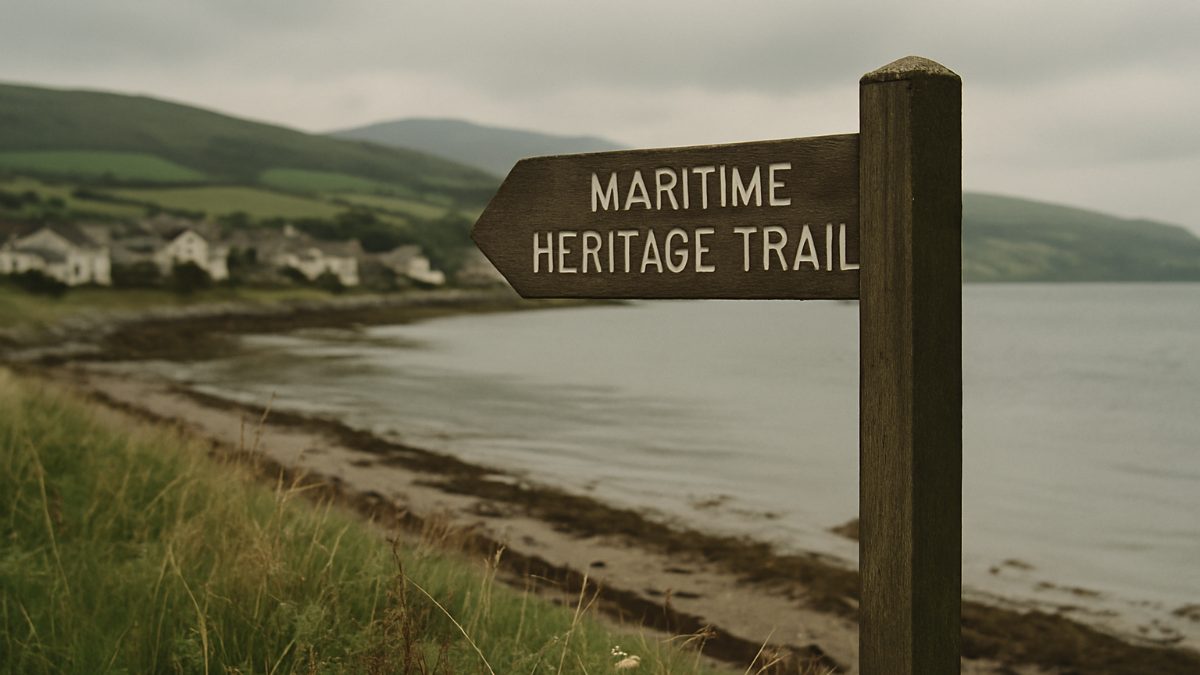
If you've spotted a brown sign near a harbour wall pointing to a "maritime heritage trail" and wondered what you were actually supposed to do with it, you're not alone. These trails exist all around Ireland's coast, but how they work isn't always obvious, especially for first-time visitors who just want to make the most of their time somewhere.
So what is a maritime heritage trail?
At its simplest, it's a marked route that connects places significant to a coastal community's history. That might mean old quaysides, fish stores, coastguard stations, lighthouses, boat-building yards, or sites linked to emigration, smuggling, fishing traditions, or sea trade. The trail gives those places a sequence and some context, usually through a combination of signage on the ground and a printed or downloadable guide.
They're not museums. You're moving through a lived landscape, past working harbours and people's homes, with information offered at intervals rather than all at once. Some sites will have interpretation panels. Others will just be there, requiring a bit of background reading on your part to understand what you're looking at.
How are they signed?
Most use the standard brown tourism signage you'll see across Ireland, sometimes with a specific trail logo or symbol. Waymarkers are typically fixed to walls, posts, or piers. In older or less maintained trails, some markers may be faded or missing, so carrying the paper map or having the route saved on your phone is genuinely useful rather than optional.
Not every maritime trail is a continuous walking route. Some are driving trails covering a stretch of coast, with short walks at each stopping point. Others are purely pedestrian and contained within a town or village. A few are a mix, which can catch people out if they assume they can do the whole thing on foot.
How does it work in practice? The Waterford coast as an example.
The Waterford coastline is a good place to think about this concretely. The county has a long relationship with the sea, from the Norse origins of Waterford city to the fishing villages along the Copper Coast and the trade history of Dunmore East and Passage East. These aren't separate stories. They connect, and a well-designed trail helps you follow those connections rather than arriving at each spot cold.
Dunmore East is a useful starting point. The harbour there was built in the early nineteenth century as a mail packet station, and the physical structure of the village still reflects that history. Walking the trail here means moving between the harbour, the older fishermen's cottages above it, and interpretation points that explain how the place functioned at different periods. None of it takes very long on foot, but it repays going slowly.
From there, the Copper Coast, which runs roughly between Tramore and Dungarvan, has its own heritage layer around the mining industry that once operated close to the shoreline. You'd need a car for that stretch. The trail logic shifts from foot pace to a series of stopping points along the coast road, each one making more sense if you've read a little before you arrive.
Passage East, further up the estuary, adds another dimension entirely, being the crossing point used by Strongbow's forces in 1170 and still operating as a ferry crossing today. Standing at the slipway knowing that context changes the place. That's what these trails are designed to do.
What should you bring and how should you prepare?
Pick up the printed trail guide from a local tourist office or heritage centre if one exists. They're often better than the digital versions because they include local detail that doesn't always make it online. Ordnance Survey maps at 1:50,000 scale cover most of the coast in useful detail if you're planning to walk any distance beyond the marked route.
Wear sensible footwear even for what looks like a town trail. Harbour surfaces and coastal paths can be uneven, and the weather along any stretch of Irish coast can change quickly. If you're planning a longer coastal itinerary, planning a coastal walking holiday without a car takes some of the practical logistics worth thinking through in advance.
Give yourself more time than you think you need. The point of a heritage trail is to slow you down. That's not a flaw in the design.